Skip to content

Urgent urology symptoms What to do

Lower urinary tract

Urology TodayPublished June 17, 20103 min read
Lower urinary tract

Key points

  • The lower urinary tract originates from the cloaca, the section of primitive hindgut into which the mesonephric ducts and embryonic ureters drain.
  • While the bladder is taking shape in the upper portion of the urogenital canal, the distal ureter and mesonephric duct begin to separate.
  • In the female the urethra is derived entirely from the distal portion of the urogenital canal, whereas in the male the urogenital canal gives rise to the posterior urethra and the anterior urethra is created by the closure of the urogenital groove.
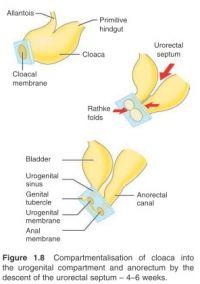
  • Clinical considerations The spectrum of cloacal anomalies encountered in clinical practice correlates closely with varying degrees of failed or incomplete descent of the urorectal septum.
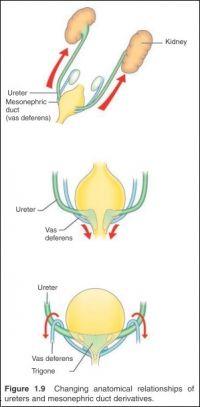
The lower urinary tract originates from the cloaca, the section of primitive hindgut into which the mesonephric ducts and embryonic ureters drain.

Between the fourth and sixth weeks of gestation, the cloaca is subdivided by the descent of the urorectal septum towards the perineum and by lateral ingrowth of the folds of Rathke. The effect is to compartmentalise the cloaca into the urogenital canal anteriorly and the anorectal canal posteriorly.

While the bladder is taking shape in the upper portion of the urogenital canal, the distal ureter and mesonephric duct begin to separate.

The mesonephric ducts migrate caudally to join into the developing posterior urethra, whereas the ureters remain relatively fixed at their point of entry in the developing bladder (Figure 1.9). The adjacent mesenchyme of the pelvis undergoes differentiation into the detrusor, a smooth muscle component of the bladder wall, in response to induction by contact with the embryonic urothelium.

In the female the urethra is derived entirely from the distal portion of the urogenital canal, whereas in the male the urogenital canal gives rise to the posterior urethra and the anterior urethra is created by the closure of the urogenital groove.

Compartmentalisation  of  cloaca  into the  urogenital  compartment  and  anorectum  by  the descent of the urorectal septum

Figure 1.8 Compartmentalisation of cloaca into the urogenital compartment and anorectum by the descent of the urorectal septum – 4-6 weeks.
The allantois protrudes from the dome of the fetal bladder like an elongated diverticulum, extending into the umbilical cord. Subsequently, the obliterated allantois persists as the median umbilical ligament. Rarely, the allantois remains patent, giving rise to a congenital umblical urinary fistula (patent urachus) or an encysted remnant.

Clinical considerations
The spectrum of cloacal anomalies encountered in clinical practice correlates closely with varying degrees of failed or incomplete descent of the urorectal septum.

Changing  anatomical  relationships  of ureters and mesonephric duct derivatives

Figure 1.9 Changing anatomical relationships of ureters and mesonephric duct derivatives.

The embryological origins of bladder exstrophy and epispadias are less readily apparent, but probably result from early defects of the cloacal membrane. Incomplete ureteric duplication results from bifurcation of the ureteric bud.

Complete ureteric duplication is characterised by a pattern of ureteric anatomy in which the ureter draining the upper pole paradoxically enters the urinary tract more distally than the lower pole ureter (in some cases draining ectopically into the vagina).

This anatomical configuration (described by the Meyer-Weigert law) occurs when the mesonephric duct separates from the embryonic lower pole ureter and descends towards the developing posterior urethra (with a tendency to take the upper pole ureter with it).

——
David FM Thomas FRCP FRCPCH FRCS
St James’s University Hospital
Leeds, UK

Patrick G Duffy MB BCH BAO FRCS(I) FEBU
Great Ormond Street
Hospital for Sick Children
London, UK

Anthony MK Rickwood MA FRCS
Formerly of Royal Liverpool
Hospital for Sick Children
Liverpool, UK
The content on this site is for information only and is not a substitute for professional medical advice, diagnosis or treatment. If you cannot pass urine, have a fever with back or side pain, or sudden severe pain in the testicle, call 911 or go to an emergency department.

Unemployment linked to rise in prostate cancer deaths
Featured Urology

Advanced viral gene therapy eradicates prostate cancer in preclinical experiments

Even with the best available treatments, the median survival of patients with metastatic, hormone-refractory prostate cancer is only two to three years. Driven by the need for more effective therapies for these patients, researchers at VCU Massey Cancer Center and the VCU Institute of Molecular Medicine (VIMM) have developed a unique approach that uses microscopic

6 min read

prostate cancer
Featured Urology

Recurrence of prostate cancer detected earlier with innovative PSMA-ligand PET/CT

A recent study reported in The Journal of Nuclear Medicine compared use of the novel Ga-68-PSMA-ligand PET/CT with other imaging methods and found that it had substantially higher detection rates of prostate-specific membrane antigen (PSMA) in patients with biochemical recurrence after radical prostatectomy. Discovering a recurrence early can strongly influence further clinical management, so it

4 min read

Two major studies strengthen case for prostate cancer drug before chemotherapy
Featured Urology

Two major studies strengthen case for prostate cancer drug before chemotherapy

Pioneering prostate cancer drug abiraterone significantly extends the lives of men with advanced prostate cancer if given before chemotherapy, the results of a major phase III clinical trial have shown. The results, published in Lancet Oncology, showed that men with advanced, aggressive prostate cancer lived more than four months longer on average if they received

6 min read

Urinary symptoms?

Weak stream, urgency, up at night? Score it in two minutes.

Seven questions from the International Prostate Symptom Score show whether symptoms are mild, moderate or severe, and when to see a doctor.

Take the symptom score

When to get help

Most urology problems can wait for an appointment. These can’t.

Call 911 or go to an emergency department if you have any of these:

  • You cannot pass urine at allAcute urinary retention: a painful, swollen bladder. It needs a catheter, often within hours.
  • Fever or chills with back or side painA blocked, infected kidney (for example behind a stone) can turn into sepsis quickly.
  • Sudden, severe pain in a testiclePossible testicular torsion. The testicle can often be saved only within about 6 hours.
  • An erection lasting over 4 hoursPriapism. Without treatment it can cause permanent damage.
Call 911

Outside the US, call your local emergency number.

See a doctor within days

  1. 01Blood in your urineEven once, and even without pain. Usually harmless, but it is the most common first sign of bladder and kidney cancer.
  2. 02Burning, frequent or cloudy urineTypical of a urinary tract infection, which usually clears with treatment.
  3. 03A lump or swelling in a testicleMost lumps are benign; testicular cancer is very treatable when found early.

General guidance only. If you are unsure how urgent a symptom is, call your doctor or a nurse advice line.