Skip to content

Urgent urology symptoms What to do

Prostatic & Seminal Vesicle Stones

Urology TodayPublished July 25, 20102 min read

Key points

  • Prostatic calculi are found within the prostate gland per se and are found uncommonly within the prostatic urethra.
  • A: Plain abdominal radiograph demonstrating 2 bladder calculi.
  • Seminal vesicle stones are smooth and hard and are extremely rare.
  • They are thought to represent calcified corpora amylacea and are rarely found in boys.

Prostatic calculi are found within the prostate gland per se and are found uncommonly within the prostatic urethra.

They are thought to represent calcified corpora amylacea and are rarely found in boys. Usually small and numerous, they are noted to be tannish gray in color during transurethral resection of the prostate. They are commonly located at the margin of the surgically resected adenoma and are composed of calcium phosphate. Although usually of no clinical significance, rarely they are associated with chronic prostatitis. Large prostatic calculi may be misinterpreted as a carcinoma.
image

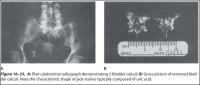
Figure 16–23. A: Plain abdominal radiograph demonstrating 2 bladder calculi. B: Gross picture of removed blad-
der calculi. Note the characteristic shape of jack-stones typically composed of uric acid.

The prostate is usually mobile, however, and a radiograph or transrectal ultrasound helps to confirm the diagnosis.

{embed=“ref/stat-menu-stone-disease-s”}

Seminal vesicle stones are smooth and hard and are extremely rare. They may be associated with hematospermia. Physical examination reveals a stony hard gland, and when multiple stones are present, a crunching sensation may be noted. These stones occasionally are confused with tuberculosis of the seminal vesicle.
image

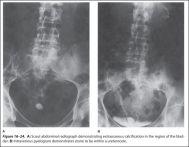
Figure 16–24. A: Scout abdominal radiograph demonstrating extraosseous calcification in the region of the blad-
der. B: Intravenous pyelogram demonstrates stone to be within a ureterocele.

###

Marshall L. Stoller, MD

—-
REFERENCES

  1. Ackermann D et al: Influence of calcium content in mineral water on chemistry and crystallization conditions in urine of calcium stone formers. Eur Urol 1988;14:305.
  2. Allie-Hamdulay S et al: Prophylactic and therapeutic properties of a sodium citrate preparation in the management of calcium oxalate urolithiasis: Randomized, placebo-controlled trial. Urol Res 2005;33:116.
  3. Bilezikian JP et al: Primary hyperparathyroidism: New concepts in clinical, densitometric and biochemical features. J Intern Med 2005;257:6.
  4. Fellstrom B et al: Dietary habits in renal stone patients compared with healthy subjects. Br J Urol 1989;63:575.
  5. Gentle DL et al: Geriatric nephrolithiasis. J Urol 1997;158:2221.
  6. Heller HJ et al: Effect of dietary calcium on stone forming propensity. J Urol 2003;169:470.
  7. Langley SE, Fry CH: The influence of pH on urinary ionized [Ca2+]:

Full References »

The content on this site is for information only and is not a substitute for professional medical advice, diagnosis or treatment. If you cannot pass urine, have a fever with back or side pain, or sudden severe pain in the testicle, call 911 or go to an emergency department.

Common Urological Problems

What you need to know about Kidney Stones

The torment of a kidney stone attack is not easily forgotten. It is often impossible to believe that something so little can cause so much pain. Most people who have suffered through such an episode are highly motivated to do anything necessary to avoid another attack. Unfortunately, despite their initial good intentions, people who have

7 min read

Common Urological Problems

Treatment of Gonococcal Infections

There are an estimated 600,000 new gonococcal infections per year in the United States. In men, most infections cause symptoms that cause the patient to seek treatment soon enough to prevent serious sequelae. However, this may not be soon enough to prevent transmission of infection to sex partners. In contrast, many gonococcal (and also chlamydial)

4 min read

Common Urological Problems

Urethritis in Men

Urethritis, or urethral inflammation, is often caused by infection. Characteristically, patients complain of urethral discharge and dysuria. On examination the discharge may be purulent or mucopurulent. Asymptomatic infections are common (McCormack and Rein, 1990; Krieger, 1996; Centers for Disease Control and Prevention, 1998). The most important pathogens are bacteria, Neisseria gonorrhoeae, and Chlamydia trachomatis. Testing

7 min read

Urinary symptoms?

Weak stream, urgency, up at night? Score it in two minutes.

Seven questions from the International Prostate Symptom Score show whether symptoms are mild, moderate or severe, and when to see a doctor.

Take the symptom score

When to get help

Most urology problems can wait for an appointment. These can’t.

Call 911 or go to an emergency department if you have any of these:

  • You cannot pass urine at allAcute urinary retention: a painful, swollen bladder. It needs a catheter, often within hours.
  • Fever or chills with back or side painA blocked, infected kidney (for example behind a stone) can turn into sepsis quickly.
  • Sudden, severe pain in a testiclePossible testicular torsion. The testicle can often be saved only within about 6 hours.
  • An erection lasting over 4 hoursPriapism. Without treatment it can cause permanent damage.
Call 911

Outside the US, call your local emergency number.

See a doctor within days

  1. 01Blood in your urineEven once, and even without pain. Usually harmless, but it is the most common first sign of bladder and kidney cancer.
  2. 02Burning, frequent or cloudy urineTypical of a urinary tract infection, which usually clears with treatment.
  3. 03A lump or swelling in a testicleMost lumps are benign; testicular cancer is very treatable when found early.

General guidance only. If you are unsure how urgent a symptom is, call your doctor or a nurse advice line.