Johns Hopkins University graduate students have invented a device to reduce the risk of infection, clotting and narrowing of the blood vessels in patients who need blood-cleansing dialysis because of kidney failure.
The device, designed to be implanted under the skin in a patient’s leg, would give a technician easy access to the patient’s bloodstream and could be easily opened and closed at the beginning and end of a dialysis procedure.
The prototype has not yet been used in human patients, but testing in animals has begun.
The students learned about the need for such a device last year while accompanying physicians on hospital rounds as part of their academic program. They watched as one doctor performed a procedure to open a narrowed blood vessel at a kidney patient’s dialysis access site. They learned that this narrowing was a common complication facing kidney patients.
The students discovered that kidney failure each year requires 1.5 million people globally and 350,000 in the United States alone to undergo regular hemodialysis to prevent a fatal buildup of toxins in the bloodstream. The students also learned that the three most common ways to connect the machine to a patient’s bloodstream work only for a limited time because of problems with infection, blood clots and narrowing of the blood vessels. Current dialysis access options are “grossly inadequate,” contributing to increased healthcare expenses and, in some cases, patient deaths, the students say.
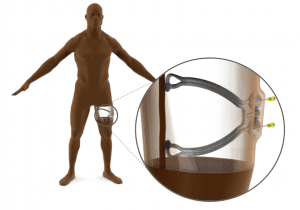
This illustration shows the Hermova Port attached to the femoral vein beneath the skin, where the student inventors say the risk of infection is reduced.
To address these problems, the students developed an access port that can be implanted in the leg beneath the skin, reducing the risk of infection. The Hemova Port’s two valves can be opened by a dialysis technician with a syringe from outside the skin. The technician can similarly close the valves when the procedure is over, an approach that helps avoid infection and clotting. The device also includes a simple cleaning system, serving as yet another way to deter infections.
Currently, most dialysis access sites are in the arm or the heart. The Hemova device instead is sutured to the leg’s femoral vein, avoiding the unnaturally high blood flows that cause vessel narrowing when dialysis machines are connected to veins and arteries in the arm. The student inventors say the Hemova Port’s leg connection should allow the site to remain in use for a significantly longer period of time.
The port won a $10,000 first prize for Johns Hopkins graduate students in the 2011 ASME Innovation Showcase. The competition, involving 10 collegiate teams, was conducted in Texas earlier this month at the annual meeting of ASME, founded in 1880 as the American Society of Mechanical Engineers. Judges based their awards on technical ingenuity, quality of business plans, potential for success in the marketplace and other factors.
The five biomedical engineering students on the team were enrolled in a one-year master’s degree program in the university’s Center for Bioengineering Innovation and Design. Sherri Hall, Peter Li, Shishira Nagesh, Mary O’Grady and Thora Thorgilsdottir all recently graduated, but Li has remained in Baltimore to form a company that will continue to test and develop the project.
With help from the Johns Hopkins Technology Transfer staff, the team has filed for three provisional patents covering their technology. The patents list the five students and three medical faculty advisers as the inventors.
“Winning first-place in the ASME competition is a great honor,” Li said. “The award and the recognition will go a long way toward helping to continue further research, and we hope it will bring us closer to the day when our device is available to help dialysis patients.”
The Hemova team has applied for a $50,000 grant to conduct more animal testing in the coming months. Clinical trials involving human patients could begin as soon as 2013, the students said.
The students’ clinical advisers were Johns Hopkins School of Medicine faculty members Thomas Reifsnyder, an assistant professor of surgery; and Kelvin Hong and Clifford R. Weiss, assistant professors of radiology.
###
Source: Johns Hopkins University